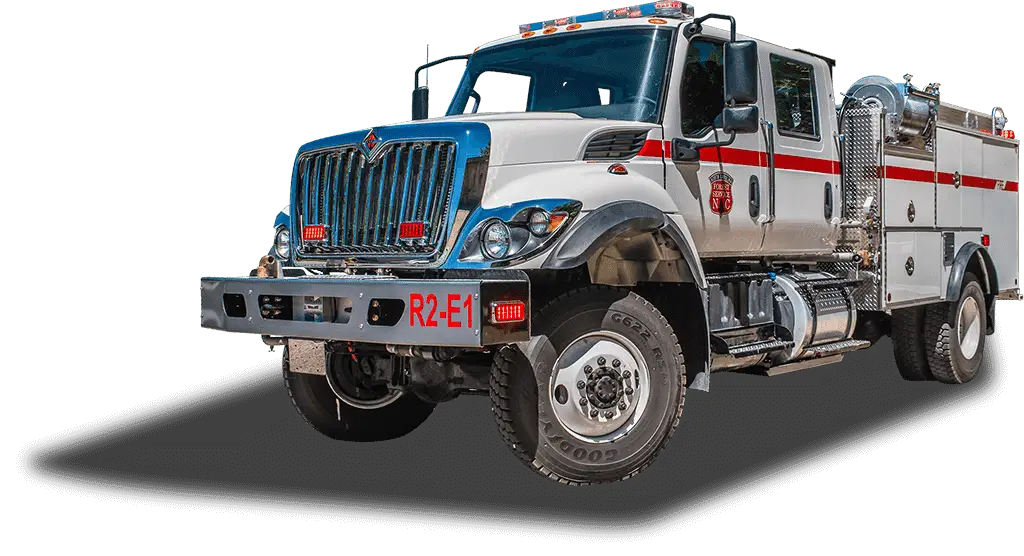
Most people think a fire truck can only do one job.
But on the scene, different fires demand completely different response strategies, and the apparatus built for those environments reflects that reality. The truck that performs well on a downtown commercial structure fire may be the wrong tool for a fast-moving brush fire in steep terrain. Likewise, a highly mobile wildland unit would struggle to support sustained operations at a multi-story apartment fire.
Modern fire apparatus are built around the conditions departments actually face, not just around generic specifications. And increasingly, those conditions are becoming more extreme.
Structural Fires: Built for Sustained Operations
Structural fires are what most people picture first—such as house fires, commercial buildings, warehouses, and apartment complexes.
These incidents demand sustained suppression capability and coordinated operations. Firefighters are not only attacking the fire itself, but also conducting searches, ventilating structures, protecting exposures, and maintaining water supply under constantly changing conditions. That’s why structural engines prioritize pumping power, hose deployment, compartment storage, and crew efficiency. In urban settings, especially, the apparatus effectively becomes a rolling toolbox supporting multiple operations at once.
But the challenge is rarely as simple as “spray water until the fire goes out.”
Modern building materials burn hotter and fail faster than many older construction types. Synthetic furnishings can push a room to flashover in minutes. Commercial fires often involve hazardous materials, complex layouts, or heavy fuel loads that require large-volume water delivery for extended periods. A structural engine is designed for sustained fighting.
Wildland Fires: Mobility Becomes Survival
Wildland response changes the equation entirely. Out in brush, timber, or grassland, access often matters more than raw water capacity. Crews may need to navigate narrow trails, steep grades, soft terrain, or areas with no established roads. Fires can shift direction rapidly with changing wind and terrain, forcing apparatus to remain mobile while operating.
That’s why wildland engines are typically smaller, lighter, and more agile than municipal structure engines. Ground clearance, wheelbase, pump-and-roll capability, and vehicle protection systems suddenly become critical design priorities. In these environments, firefighters are often trying to stop a fire before it grows into something far more dangerous. A quick initial attack can mean the difference between a contained vegetation fire and a large-scale incident threatening homes, infrastructure, or entire communities. The apparatus must move quickly, remain reliable in tough terrain, and keep functioning far from hydrants or support infrastructure. And increasingly, departments are dealing with longer wildfire seasons and more unpredictable fire behavior than they did even a decade ago.
Vehicle Fires: Faster, Hotter, More Complex
Vehicle fires used to be relatively straightforward compared to today’s standards.
Modern vehicles are filled with synthetic materials, pressurized systems, lightweight alloys, and increasingly, high-capacity lithium-ion batteries. Fires involving electric vehicles have introduced entirely new suppression challenges, including reignition risks that can continue long after flames appear extinguished.
For firefighters, vehicle fires are less about sheer water volume and more about speed, positioning, and adaptability.
Crews may be operating inches from moving traffic while managing toxic smoke, exploding tires, ruptured fuel systems, or compromised battery packs. The response apparatus needs rapid deployment capability and versatile equipment layouts that allow crews to adapt quickly.
It’s one of the clearest examples of how firefighting evolves alongside technology itself.
WUI Fires: The Most Demanding Environment
Wildland-Urban Interface fires — commonly called WUI fires — combine the challenges of structural and wildland firefighting into a single incident.
These are some of the most demanding environments apparatus will ever operate in.
A crew may need to defend homes one moment, then transition into mobile wildland attack the next. Water supply may be limited. Terrain may be rough. Smoke conditions may reduce visibility to almost nothing. Meanwhile, structures, vegetation, wind, and ember cast are all driving fire behavior simultaneously.
Traditional apparatus categories start to blur in these incidents.
Departments increasingly need trucks capable of handling multiple operational roles without sacrificing reliability. That shift has changed how many agencies approach apparatus purchasing altogether. Flexibility and real-world usability now matter as much as raw specifications.
Because on WUI incidents, conditions rarely stay predictable for long.
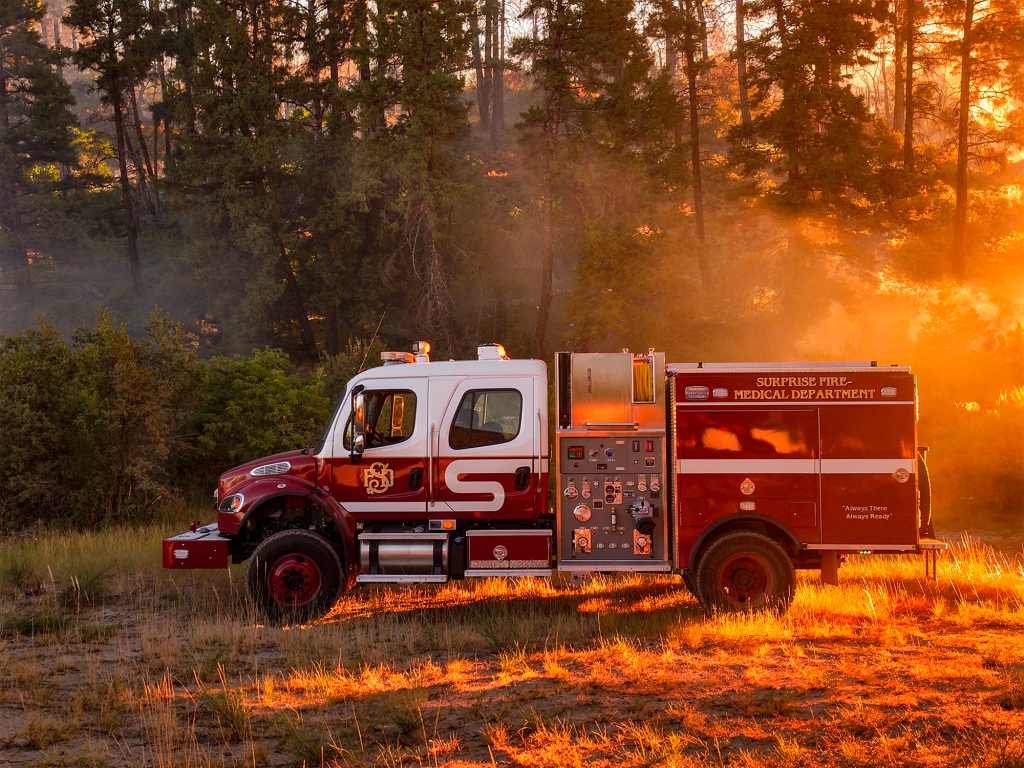
Fire Apparatus Are Built Around Environment
One of the biggest misconceptions about fire apparatus is that bigger automatically means better.
In reality, the best apparatus are the ones built for the environment they serve.
A rural department operating without hydrants has different priorities than a downtown urban department. Mountain agencies deal with terrain and weather conditions flatland departments may never encounter. Coastal regions face corrosion concerns. Snow-prone areas require different operational considerations than desert environments.
The apparatus reflects all of it.
The most effective trucks are rarely designed around marketing language or spec-sheet bragging rights. They are shaped by firefighter feedback, operational experience, maintenance realities, and the hard lessons departments learn after years of responding in difficult conditions.
That experience matters.
Because when crews arrive at a fire, the apparatus cannot simply look capable. It has to perform under pressure, often in the worst conditions imaginable.
The Future of Fire Response Is Changing
Fire behavior is evolving. Communities are expanding deeper into vegetation-heavy areas. Vehicle technology is changing rapidly. Departments are being asked to do more with fewer resources.
As a result, fire apparatus design is evolving too.
Many departments are now looking for equipment that balances specialization with adaptability — apparatus capable of handling multiple operational demands without compromising reliability in the environments they serve most.
The future of firefighting will not be defined by one universal truck capable of everything.
It will be defined by smarter apparatus designed around how fires actually behave, how firefighters actually operate, and how quickly conditions can change once the tones drop.